
Back to homepage

Mass. Bioheat dealer sports new truck wrap in marketing effort

By Jenna Higgins Rose | June 26, 2012

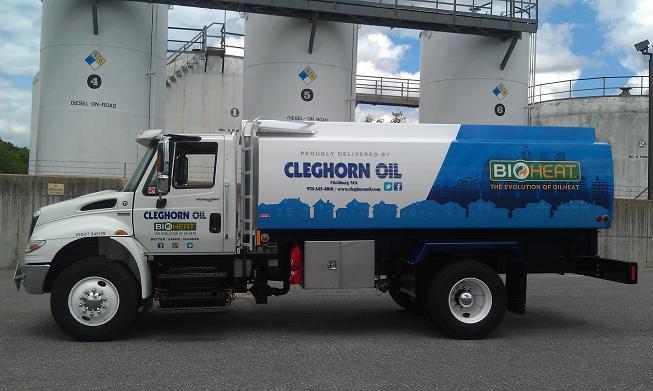
Cleghorn Oil, a Bioheat dealer based in Fitchburg, Mass., is proudly waving the Bioheat flag. The company recently received a professional Bioheat truck wrap to help its marketing efforts, courtesy of the National Biodiesel Board’s Bioheat outreach program.

“I’ve never seen a more beautiful truck,” said Ryan Roy, the company’s director of operations. “This is the crown jewel, the showpiece of our fleet. I almost want to put it on a pedestal and keep it as a trophy. People see it and say, ‘Wow, I’ve never seen anything like that.’” 

Cleghorn, which changed its oilheat line exclusively to Bioheat this year, won the wrap at the New England Bioheat Symposium in Boston in March. The application of the wrap was paid for thanks to funding from the Nebraska Soybean Board and the United Soybean Board through the soybean checkoff, but the artwork is available to all registered Bioheat dealers.

The company plans on parading the wrapped truck to area residents—literally. It is scheduled to appear in the Fourth of July parade in Fitchburg and another parade in August.     

Roy said the company first learned about Bioheat from a meeting with the team of Paul Nazzaro, NBB’s petroleum industry liaison. 

“We jumped on board because it seemed like the right thing to do,” Roy said. “Bioheat is better for the country, better for the burner, and cleaner. It’s working for us.”

Through the Bioheat program, the company uses post cards, door hangers, and other literature to educate its customers on Bioheat. Roy said the support he’s received from Nazzaro’s team, through NBB, has been tremendous. 

Oscar Charron Sr. founded Cleghorn Oil in 1923, using a hand-cranked pump to deliver oilheat in 5-gallon buckets, Roy said. He’s a fifth-generation family member helping to run the business today. 

“I think Oscar would like the direction we’re going in,” Roy said. “He’d be happy with how we’ve grown through the Depression and World War II, and how his company has evolved from a small garage to where we are now.”   

Bioheat is a big stepping stone for this country and the future of the oilheat industry, he said.

For more information on Bioheat, visit BioheatOnline.com.   


3 Responses

  1. Rahoma

    2012-07-17

    1

    I would buy 100% conventional hnetiag oil but put the money saved by not purchasing B99 toward purchases that would lower our energy use and/or allow us to switch to more sustainable energy sources. In addition to the petroleum used in the production of biofuels you should also consider other issues associated with the industrial agricultural practices that are part and parcel of the biofuels industry (many of which are also discussed in OD): (1) the fertilizers, herbicides, pesticides and machinery used in the production of these crops are polluting our air, water and soils; (2) many of the crops used to make biofuels are genetically engineered open pollinated varieties that are polluting our traditional seed varieties; (3) the tillage and irrigation practices are leading to massive soil erosion which will eventually make the land unsuitable for agriculture of any kind. And there are more.Incidentally I don't feel that the new trend of using crop waste to make biofuels is a particularly sustainable approach either as sustainable farming methods require the return of organic matter to the soil; and traditionally a significant portion of this organic matter came from crop waste. There also have been attempts to use crops grown on lands otherwise unsuitable for agricultural use. This addresses the issue of using food as fuel, but doesn't change the fact that it involves bringing even more land under unsustainable and harmful industrial practices.I think the question is less one of whether or not biofuels use less petroleum than simply burning conventional oil, and more one of whether or not the biofuels industry is overall a sustainable alternative to petroleum. I don't think it is. And therefore I wouldn't encourage the growth of this industry by purchasing its products.

  2. Robert Cerio, Ocean State Energy Resources

    2012-07-22

    2

    Thank you for taking time to share your viewpoints about Bioheat and Biofuels. As a team member of the National Biodiesel Board's petroleum outreah team I would like to respond to your remarks in the order which you made them. I will start by addressing the first concern along with the three more specific questions whereas they are closely related and can often be very confusing. I will then focus on the later of your two concerns/opinions. I also would be pleased to send you via e-mail a statement from the EPA defining Biodiesel as Americas first Advanced Biofuel as well as several documents that will help give a better understanding of biodiesel as a domestic, sustainable, renewable energy resource. Your Question #1, when the life cycle cost, energy balance and life cycle greenhouse gas emissions were analyzed for biodiesel by United States EPA, National Renewable Energy Labratory (NREL) and several other highly respected laboratories and state universities as compared to petroleum based fuel biodiesel came out on top every time. The basis for their analytical research performed took into account all the impacts and concerns listed in your first concern outlined in question number one. Advanced Biodiesel from soy oil is defined as having 56% less Life Cycle Greenhouse Gas emissions than petroleum based fuel and second generation (recycled) feed stocks such as waste vegetable oils, animal fats and tallows have 76% lower greenhouse gas emissions than that of petroleum based fuel. Your Question #2, the majority of the crops grown in the United States today are genetically engineered to produce more, higher quality foods per acre from plants that are drought tolerant, insect and disease resistant to help feed our nation. If they were not we would be almost as dependent on Soy is planted and germinated by seed and is an annual crop having to be planted each year and is field rotated as well. There is less chance of cross pollination and pollution of the species seed because farmers are purchasing a seed that meets the specific demand of their crop. Your Question #3, about 60 to 70 % of the biodiesel produced in the United States is from soybean oil. The remaining is produced from recycled waste vegetable oils, animal fats and tallows which is the most sustainable model for biodiesel production. That said soy is one of the best soil conservation crops that we grow in the country. The soybean is harvested oil extracted and used for biodiesel production and other food products and the meal 90% of the crop is utilized for food production. The plant a dense, lush, green low bush type plant is left untouched. The plant and roots are eventually tilted to be used as a soil amendment crop adding or replacing organic matter and nutrients. Soy is commonly referred to as a green manure crop. Soy is also as I mentioned in response to your second question is a rotational crop species. So the field is rested for one or two years and another green manure crop such as winter wheat or annual rye grass gets planted during the rest period to reduce soil erosion, add organic matter and nutrients as a soil amendment crop. These crops typically do not require a great deal of care such as watering, fertilizer and pest control. Concerns and Opinions: With regard to Biofuels and their sustainability I would ask first that we look at the definition of sustainability: Sustainability can be defined as “meeting the needs of the present without compromising the ability of future generations to meet their needs”. (Brundtland Report 1987) Our current rate of use of petroleum based fuels is certainly not sustainable especially considering we are working with a finite resource. If biofuels are not the silver bullet that we hope they are they certainly are a better bridging technology than the former. Biofuels are renewable infinite resources that have a much lower environmental impact than petroleum. Not to mention reducing our dependency on foreign resources, creating jobs in the US and keeping our farmers working. Thank you for your concerns and questions they help to keep us moving in the right direction to a more renewable, sustainable energy future. If you wish to have several PDF files sent to you via e-mail to substantiate my responses please provide your e-mail and I will do so immediately.

  3. Ron Kotrba

    2012-07-23

    3

    Bob, thank you for the thoughtful reply to Rahoma's post.

  4.  

    Leave a Reply

    Biodiesel Magazine encourages civil conversation and debate. However, comments containing personal attacks, profanity, business solicitations or other advertising will be deleted.

    Comments are closed

 
Array ( [PATH] => /sbin:/usr/sbin:/bin:/usr/bin [PP_CUSTOM_PHP_INI] => /var/www/vhosts/biodieselmagazine.com/etc/php.ini [FCGI_ROLE] => RESPONDER [REDIRECT_REDIRECT_PP_CUSTOM_PHP_INI] => /var/www/vhosts/biodieselmagazine.com/etc/php.ini [REDIRECT_REDIRECT_STATUS] => 200 [REDIRECT_PP_CUSTOM_PHP_INI] => /var/www/vhosts/biodieselmagazine.com/etc/php.ini [REDIRECT_STATUS] => 200 [HTTP_HOST] => biodieselmagazine.com [HTTP_X_REAL_IP] => 54.234.42.16 [HTTP_X_FORWARDED_FOR] => 54.234.42.16 [HTTP_X_ACCEL_INTERNAL] => /internal-nginx-static-location [HTTP_CONNECTION] => close [HTTP_ACCEPT_ENCODING] => x-gzip, gzip, deflate [HTTP_USER_AGENT] => CCBot/2.0 [HTTP_ACCEPT_LANGUAGE] => en-us,en-gb,en;q=0.7,*;q=0.3 [HTTP_ACCEPT] => text/html,application/xhtml+xml,application/xml;q=0.9,*/*;q=0.8 [SERVER_SIGNATURE] =>
Apache Server at biodieselmagazine.com Port 80
[SERVER_SOFTWARE] => Apache [SERVER_NAME] => biodieselmagazine.com [SERVER_ADDR] => 64.207.180.117 [SERVER_PORT] => 80 [REMOTE_ADDR] => 54.234.42.16 [DOCUMENT_ROOT] => /var/www/vhosts/directory.biodieselmagazine.com/httpdocs/biodieselmagazine.com [SERVER_ADMIN] => jkeller@bbiinternational.com [SCRIPT_FILENAME] => /var/www/vhosts/directory.biodieselmagazine.com/httpdocs/biodieselmagazine.com/app/webroot/index.php [REMOTE_PORT] => 60297 [REDIRECT_QUERY_STRING] => url=articles/8560/mass-bioheat-dealer-sports-new-truck-wrap-in-marketing-effort [REDIRECT_URL] => /app/webroot/articles/8560/mass-bioheat-dealer-sports-new-truck-wrap-in-marketing-effort [GATEWAY_INTERFACE] => CGI/1.1 [SERVER_PROTOCOL] => HTTP/1.0 [REQUEST_METHOD] => GET [QUERY_STRING] => url=articles/8560/mass-bioheat-dealer-sports-new-truck-wrap-in-marketing-effort [REQUEST_URI] => /articles/8560/mass-bioheat-dealer-sports-new-truck-wrap-in-marketing-effort [SCRIPT_NAME] => /app/webroot/index.php [PHP_SELF] => /app/webroot/index.php [REQUEST_TIME] => 1369060289 )